Project at a glance
QIT Pod 001 hosts customer-owned GPU racks for AI inference. The site is an operating bitcoin mine in Texas with energized medium-voltage infrastructure. Instead of waiting for a new utility service, Pod 001 connects to power that already exists on the property, then adds a fitted IT container, liquid cooling and a small power skid next to the host’s mining containers.
The pod is designed to run unstaffed and remote-monitored. It is commissioned before the racks arrive, so power, coolant, fire protection and network are waiting at every rack position on delivery day.
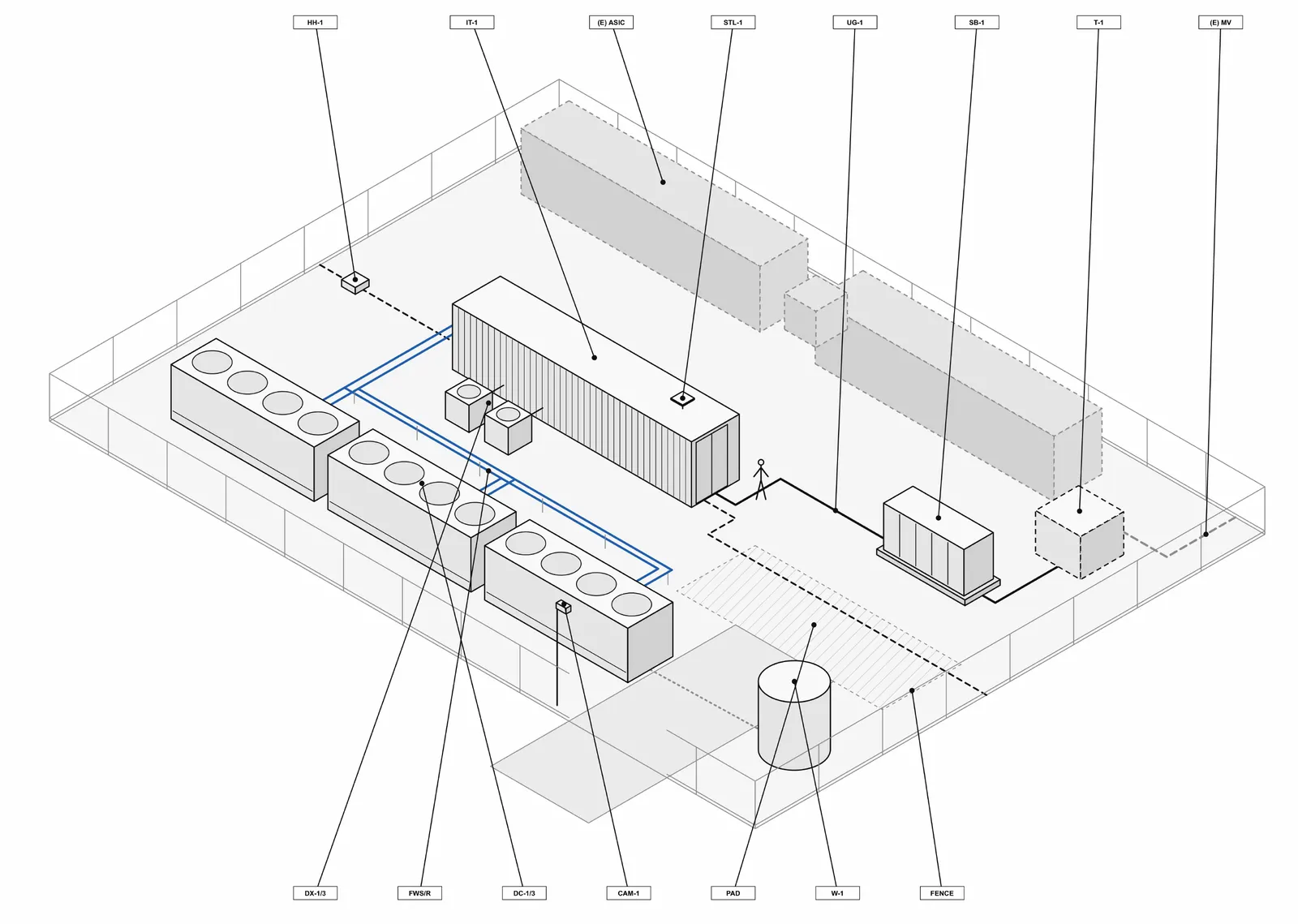
Preliminary drawings, Rev A, issued for study on November 3, 2026. Not for construction, permitting or bidding. Values marked “est.” will be confirmed by the engineering study.
Key data
| Item | QIT Pod 001 |
|---|---|
| Use | Colocation of customer-owned GPU racks for inference; unstaffed, remote-monitored |
| Location | Energized bitcoin-mining site, ERCOT, Texas |
| IT load | 6 × NVIDIA GB300 NVL72: 810 kW TDP, 930 kW peak |
| Expansion | 7th rack position reserved: +135 kW TDP / +155 kW peak |
| GPUs | 432 Blackwell Ultra GPUs at six racks; 504 with the seventh |
| Facility load | 1.15–1.25 MW (est., including cooling auxiliaries) |
| Enclosure | 40 ft high-cube fitted IT container, single aisle, steel plinth |
| Power | 415Y/240 V, 3-phase 4-wire; 2,500 A switchboard; 60 A IEC 60309 feed per power shelf |
| Cooling | Direct liquid cooling: 1 MW liquid-to-liquid CDU, 35–40 °C technology loop, adiabatic dry coolers; in-row DX for residual air |
| Fire protection | VESDA aspirating smoke detection + FK-5-1-12 clean-agent suppression |
| Network | Two diverse fiber routes, 2 × 100G uplinks; Starlink out-of-band management |
| Redundancy | N, utility-only; no UPS on IT load (space reserved), no generator |
Inside the container
The IT container is a 40 ft high-cube unit (12,030 × 2,350 × 2,700 mm inside) fitted with a single rack row on a steel plinth rated for 500 lb/ft². A GB300 NVL72 rack weighs 1,360–1,580 kg and stands 2,236–2,495 mm tall, so the floor and the service clearance are designed around the rack, not the box.
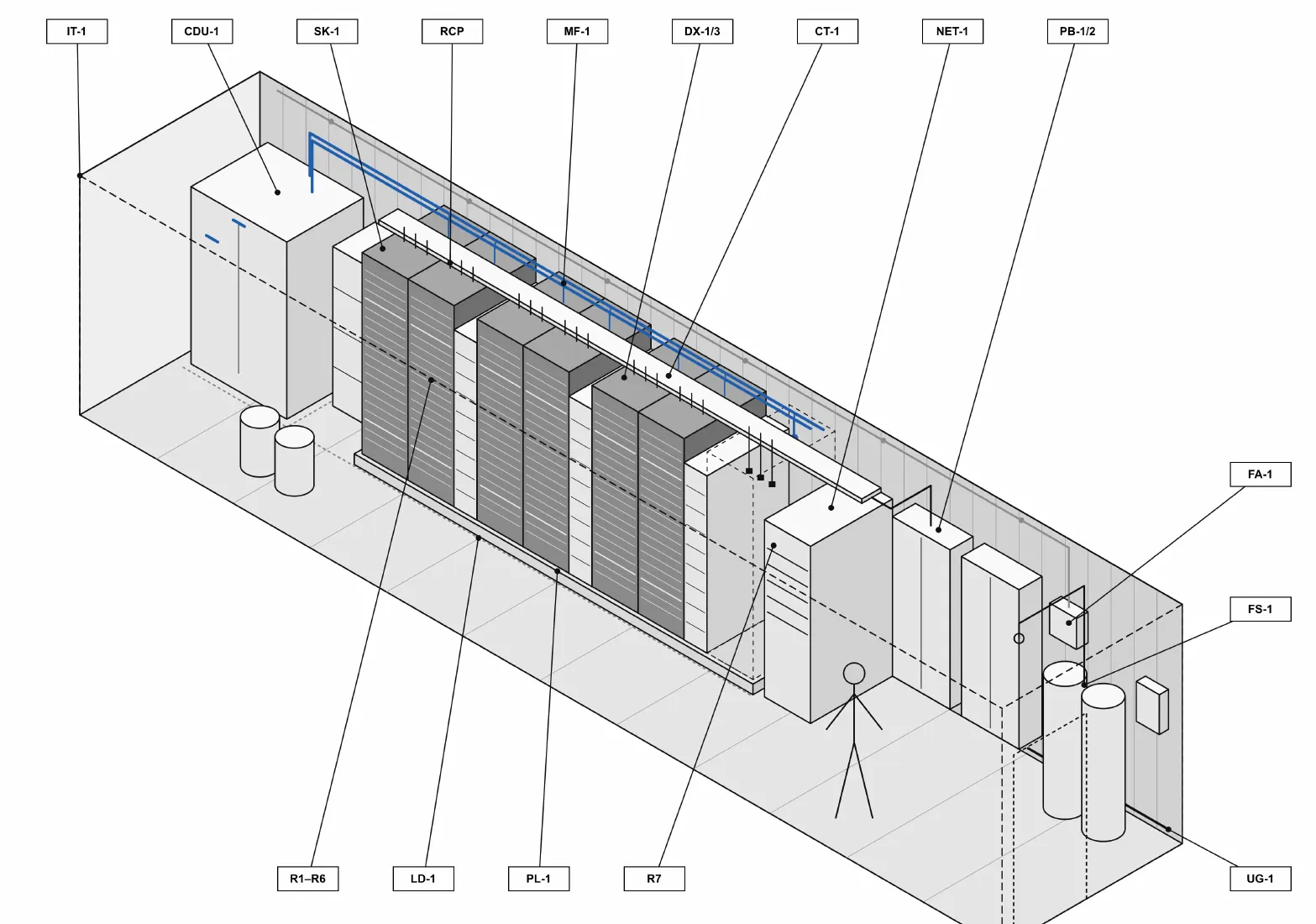
- Seven rack positions: six GB300 NVL72 racks at launch and one spare position for growth.
- Coolant manifold: overhead supply and return with UQDB04 quick disconnects at every rack.
- Power at every position: two 1,200 A wall-mounted panelboards and 60 A IEC 60309 receptacles, one per 33 kW power shelf.
- Service kit inside: spares shelf, coolant tanks and a rack lift, so routine work does not wait for a truck.
- Leak detection under the rack row and the CDU.
Power: three ways to connect
Pod 001 is designed to use the host’s existing medium-voltage system. The engineering study will confirm one of three supply variants:
| Variant | Supply | Why it matters |
|---|---|---|
| A | Reuse an existing 2,500 kVA host pad-mount transformer (34.5 kV – 415Y/240 V), freed from a retired mining container | No new transformer on the critical path |
| B1 (preferred B) | New 2,000 kVA stock pad-mount transformer tapped from the host’s private 34.5 kV collector, behind the host meter | No mining capacity retired; stock unit instead of a 40–65 week new build |
| B2 | New utility primary service | Fallback; schedule set by the utility process |
A 415Y/240 V, 4-wire system was selected because the GB300 NVL72 power shelves accept 346–480 V wye input and need a neutral. A 480 V site would require a step-down transformer.
Load summary (preliminary)
| Load | kW |
|---|---|
| IT, 6 × GB300 NVL72 (TDP / peak) | 810 / 930 |
| Future 7th rack (TDP / peak) | +135 / +155 |
| Cooling auxiliaries (CDU, coolers, DX) | 110–200 (est.) |
| Network, controls, lighting | 10–20 (est.) |
| Total facility | 1,150–1,250 (est.) |
| Current at 415 V, 0.95 PF | 1,680–1,830 A |
| Switchboard main (125% continuous) | 2,500 A, 65 kAIC |
There is no UPS on the IT load: GB300 power-shelf hold-up is 20 ms, so the design relies on the utility supply and keeps the equipment count low. Space is reserved in the switchboard for a future UPS. A small UPS keeps network, building management and fire systems alive. A revenue sub-meter logs consumption, power quality and harmonics for the host.
Cooling: liquid first
Each GB300 NVL72 rack sends about 120 kW of its heat to liquid and 13.5–17 kW to air. Pod 001 therefore uses direct liquid cooling for the racks and a small in-row air system for the remainder.
| Design data | Value |
|---|---|
| Technology loop (rack side) | 35–40 °C supply design; 45 °C max per OEM |
| Flow | 119 LPM per rack at 40 °C; 710–830 LPM total for 6–7 racks |
| CDU | Liquid-to-liquid, 1 MW at 35–40 °C, 25–50 µm filtration |
| Facility loop | PG25 glycol (freeze protection) to three adiabatic dry coolers, ~400 kW each |
| Heat rejection | 1.1–1.2 MW (est.) |
| Residual air | 120–180 kW via in-row DX units, N+1 |
| Design ambient | 38.9 °C dry bulb / 23.5 °C mean coincident wet bulb (DFW 0.4%); checked at 40.5 °C |
Texas summers set the design. Pure dry cooling cannot hold the rack loop at the design ambient, so the dry coolers use adiabatic pads on the hottest hours (about 231 hours a year above 35 °C) fed from a make-up water tank. Trim-chiller connections are installed and capped. Outside those hours, the system runs dry.
Fire, security and network
- Detection: VESDA aspirating smoke detection with staged alarms.
- Suppression: FK-5-1-12 clean agent per NFPA 2001, with an NFPA 75 power-off analysis.
- Network edge: redundant routers and firewalls in a dedicated network rack, two diverse fiber routes and 2 × 100G uplinks.
- Out-of-band: Starlink and a console server, so the site stays reachable if both fiber routes fail.
- Physical security: 8 ft fence, gate cameras and badge access.
Design references include NFPA 70, 72, 75/76 and 2001, UL 891 and UL 2755, IEEE 519, 142 and 1584, and ASHRAE TC 9.9 liquid-cooling guidelines.
Why this design
- Power that already exists. Reusing an energized transformer, or tapping a private collector with a stock unit, keeps the utility and long-lead transformers off the critical path.
- Ready before the racks. The container is commissioned first; customer racks roll in, plug in and go live.
- Built for the rack that is shipping. Voltage, neutral, coolant temperature, flow, floor loading and clearances follow the GB300 NVL72 envelope.
- Customer-owned compute. Racks, power shelves, cold plates and scale-out network belong to the customer. QIT provides the powered, cooled and connected space.
- Equipment equals accepted. The design names a basis of design, not a single vendor, so a long lead time on one product does not stop the project.
Pod 001 is a hosting configuration sized for rack-scale NVL72 systems. The standard QIT GPU container remains our 20 ft factory-built unit.
Status and next steps
Pod 001 is at the engineering study stage. The study will confirm the power variant, short-circuit and arc-flash coordination, foundations, heat-rejection sizing, water use, fire protection and the permitting path with the authority having jurisdiction and the utility.
If you own an energized site with spare capacity, or need a home for GB300 NVL72 racks, discuss a project. Read how QIT compares with other modular data center companies and the guide for bitcoin miners moving to AI.
Source: QIT-P001 drawing set (G-001 to E-601). Preliminary drawings, Rev A, issued for study on November 3, 2026. Not for construction, permitting or bidding. Values marked “est.” will be confirmed by the engineering study.
Prepared by QIT · Updated November 2, 2026
Explore all field notes